
A Thesis Presented to the Faculty of the Department of Sociology San Jose State University
In Partial Fulfillment of the Requirements for the Degree Master of Arts
By: Stephen Wayne Hull
August 1976
It has been over twenty years since I originally conducted this study, and as a result of continued requests for copies I have finally had the original manuscript converted into an electronic version. I hope that it provides readers with a useful reference point for future sociological work on related subjects. This version of the thesis is almost identical to the original and no effort has been made to update or "modernize" the concepts, language, or cultural references. Readers should be reminded that this research was conducted as a scholarly effort and had to conform to specific academic standards for organization, method, content, and writing style. It is not a natural narrative form for surfers who prefer to "talk story", and I had to pay a professional typist a lot of '70's dollars to type four different versions before the academicians were satisfied.
In retrospect, the emotional effort it took to "objectify" the activity, culture, and social fabric of an experience that I was so passionately involved with, was one of the hardest things I have ever done. As I defended the paper to my sociological colleagues, I received the usual compliments, and several suggestions that I "publish" it. I was understandably flattered, but as a surfer I felt that sending the work as a whole or in parts to surfing publications would have been suicidal. As a sociologist, I believed that in general surfers had an "unprofessional" reputation in academic circles and submission to professional journals was pointless. Life went on and in the end, I was perfectly content to put the book on the shelf, and get back to the luxury of totally subjective surfing expression.
As I read this study again after all these years, I was gratified that much of what I had written still offers useful insights. There are certain details which are totally outdated, but overall I have concluded that it is still worth sharing. Many of the names and faces in the lineup have changed significantly, but much of the structure remains. There were a few phenomena in surfing that I failed to anticipate: the return of longboarding, the "graying" of the sport, increased female participation, and the development of local/regional surfing family "dynasties." I probably could have seen them coming if I had been paying closer attention to Hawaii's modern surfing culture evolution. Oh well.
I still surf regularly, along with many of the "locals" I grew up with. It is almost unprecedented in my experience to see a social bond created so early in our lives continue to keep us close. In many cases it has outlasted families, marriages, and serious chemical addictions. While surfing has not always fit easily into the rest of my life, I have always made room for it. It has become a profound part of who I am and how I define my "self." In a world of flux, career changes, crisis, and relocation; surfing has been one of the very few consistent threads in the fabric of my life that have provided my existence with some sense of continuity.
If you are not academically inclined and surfed twenty years ago, maybe a few sections will bring back some memories. If your introduction to the sport has been more recent, have a few good laughs on me. In any case, keep the stoke.
da hulk
1. Santa Cruz Surfer's Social Class Origins
2. Non-Student Santa Cruz Surfer's Current Social Position
3. Directions of Inter-Generational Mobility Among Non-Student Surfers
in the Santa Cruz Area
4. The Racial and Ethnic Composition of Santa Cruz County Compared with a
Survey of Surfers in the Santa Cruz Area
5. Surfing Frequency and Years in Surfing
6. Surfing Involvement Score and Proportion of Friends Who Surf
7. SII Scores and Proportion of Time Surfing or Related Activity
8. SII Scores and Feelings of Commitment to Surfing
9. SII Scores and Social Class Origins
10. SII Scores and Location of Residence Relative to Surfing Areas
11. Scores and the Function of Surfing
12. Forms of Introduction to Surfing
This thesis is an attempt to describe, and to a lesser degree, analyze the surfing subculture in Santa Cruz, California. This paper is intended to provide sociologically relevant information about the surfing phenomenon, much in the tradition of the "Chicago School" of sociological study. In addition to a description of the Santa Cruz surfer's world, it is meant to test an instrument designed to measure the actor's degree of involvement in the surfing subculture, and to explore the meanings that surfing has for its members within the Santa Cruz surfing "scene." This is not meant to be an exhaustive study of surfing in Santa Cruz, nor to represent strictly empirical research. It is meant to establish a theoretically-cohesive sociological description of the surfing phenomenon and some of its relationships to the larger society.
The content of this report has relevance for several fields of study, including the sociology of sport, the study of subcultures, the study of deviance, the study of leisure, and the sociology of youth. Because of the multi-dimensional nature of this report, relevant theoretical information will be introduced where it is required or appropriate throughout the thesis.
The methods of data collection used for this study are primarily of the participant-observer type. The primary source consists of the writer's own active participation within the surfing subculture in the Santa Cruz area, and among a specific group of surfers at a Santa Cruz County beach, over a 13-year period extending from 1963 to the present. A brief autobiography is included in the appendix, describing the extent of the author's involvement in surfing. A second source of information are the interviews, both formal and informal, conducted during the past 18 months. A third source of information is the subcultural literature, consisting of several surfing periodicals and information provided by the Western Surfing Association. The fourth important source of information is a senior thesis written by a fellow surfer who attended the University of California at Santa Cruz. A fifth source of information is a survey of surfers in the Santa Cruz area, conducted during the month of July, 1974, and which is described in more detail in a subsequent section of this thesis.
Unfortunately, information regarding surfing in the Santa Cruz area, be it of a statistical nature or otherwise, is practically nonexistent. For this reason it must be made perfectly clear that this is strictly an exploratory study. There is much more work that can be done in this field.
The sociological study of sports has been very slow in being realized. It is still wrought with controversy over many of its most basic concepts and terms, not to mention its methodology. The sociology of sports has also suffered from a curious lack of interest by sociologists, both in this country and throughout the world--curious in the sense that sport has received so much media coverage and represents a significant amount of this society's interest. The past twenty years have shown an increase in recognition and development in this field, but an organized body of theory or data has not yet clearly emerged. For general purposes, A. S. Daniels (1966) has provided a tentative definition which concludes that:
"Sports sociology is concerned with the study of sport in society as it affects man's development, his forms of expression, his value systems, and the interrelationships of sport with other elements of the culture (p. 157)."
The general consensus among the sociologists of sports seems to indicate that this new study includes two basic, descriptive approaches: The first includes the study of the culture and social structure within "sport" or a specific sport; the second is directed to the study of sports or a specific sport's relationship with the larger society and its institutions.
This paper focuses primarily on these two descriptive approaches to the sport of surfing; however, it includes a third approach as well. The subcultural perspective comprises this third dimension.
The study of a sport from a subcultural perspective is not new, and has precedence both in theoretical discussions and in actual research. John W. Loy, Jr. (1969) suggests that:
"Within the sociological study of sport, studies are needed: (1) which place greater emphasis on culture and social structure rather than personality; (2) which examine small groups as micro-social systems or subsystems; and (3) which consider "real" rather than "contrived" groups. . . . One manner of getting sport out of the laboratory and to correct the three oversights . . . is to study sport groups as subcultures (p. 67)."
Thorough published research related to the subcultural perspective of sports are relatively rare, but special note should be given to several papers using such an approach (Aronson, 1952; Polsky, 1967; Scott, 1968; Stone & Oldenburg, 1967). A review of these studies has proven very helpful in facilitating this research. Even with these previous models of research to refer to, however, it has been necessary to create a new format for what the author believes to be an accurate and complete view of the surfing subculture.
The sociological term "subculture" has become a widely used concept in recent years; yet with all of this usage it has received very little critical attention. It has often been construed as synonymous with deviants and their activities, or the "sub" has somehow been interpreted to mean inferior. Neither of these versions are accurate in reference to a surfing subculture. Throughout this thesis terms like surfing scene," "surfing world," and "surfing way-of-life" are used in an effort to avoid such connotations. There is no denying that the subculture concept is applicable to the study of deviance. What is meant here is that "subculture" refers to any group of people within a culture, who formulate a way of behaving that includes some of the dominant features of this culture, and also includes certain features of this culture, not found elsewhere in the society. A quote by Etzioni (Arnold, 1970) presents a similar view:
"The American society is not a...universal melting pot, into which all ethnic groups "blend" sooner or later, by accepting the dominant culture of the real American tradition. It is, as has often been pointed out, a pluralistic society, with many subcultures and subgroups. All integrated groups accept some values of American society, but at the same time hold their own particularistic tradition and values (p. 85)."
Many sociological studies of subcultures have been based on the view that "descriptions of these subcultures must be stated in terms of the fully indoctrinated member rather than the average member . . . (Arnold, 1970, p. 86)." Within the subcultural study of sports, this has been the most common form. This is perhaps the best way of describing a sport in which there is a large and clear proportion of the group's members who are professional (i.e., totally committed). In a sport like surfing, which has so few professional participants, this view is not considered the most appropriate.
Subcultures are usually characterized by the fact that an individual can function within more than one subculture at one time, with varying degrees of commitment and sometimes pass through several stages as he grows older or his attitudes change. By including this concept of peripheral marginality (Arnold, 1970, pp. 81-89), by accepting the blurred borders which most subcultures have, an important dimension of the surfing subculture has been added. In the surfing subculture, patterned interaction is characterized by a process which includes the beginner as well as the professional.
The study of subcultures has many times been limited to a description of the group. This is a necessary first step in any study of a subculture. It is vital to define the subculture, its norms and values; it is important to describe the subculture's relation to the larger society, but something more is necessary for a study to truly contribute to sociological knowledge. There must be some effort to explain the phenomenon. In his article titled "A Process Model of Subcultures," David Arnold (1970) proposes the use of a "structural-interactionist model" approach to the study of subcultures. He describes such a model in this way:
"In examining and working with the structural-interactionist subculture model it is important to view subcultures as systems of norms, not as groups of concrete individuals. The model looks at the people involved in order to explain how the subculture develops.
The first element of the structural-interactionist model is structural position, that is, specification and description of the population segment under consideration. The second element is differential interaction...The third element of the model is the segment-related subculture, that is, the subculture that results from the differential interaction of people sharing the same structural position...Finally, as the fourth element...we have the individual manifestations of subcultural membership, i.e., individual variations in behavior, attitudes, beliefs, etc. (pp. 114-115)."
This model serves as a basis for the presentation of the surfing subculture in four different parts. Chapter two will consist of the technical and mechanical aspects of surfing which contribute to the character of the population segment who surf. Chapter three will be a description of the population segment under consideration, through the use of various demographic data and some tests of correlation. Chapter four will consist of a description of the process of becoming a surfer. It is an attempt to synthesize the nature of the central activity, the population segment who participates, the social structure that exists, the socialization process that occurs, the norms that are expressed, and the values that are imparted. Chapter five is primarily concerned with an analysis of the surfing subculture's relationship with the general culture in order to demonstrate the surfing subculture's central tendencies and its variations of marginality.
The study of subcultures is a fascinating way of viewing social life. As Thomas Lasswell (1965) has pointed out:
"...every group that is at all functional must have a culture of its own that is somewhat similar to the cultures of other groups with whom it interacts. Such a group culture is not partial or miniature, it is a complete, full-blown set of beliefs, knowledges, and ways for adjustment to the physical and social environment.. The culture itself is not smaller than the great culture...the group which enacts it is smaller than the great society (p. 211)."
Thus the study of subcultures is not only simpler and more accessible than attempts to study the larger society, it can also contribute significantly to the study of the larger society.
A problem which was encountered while preparing this report was just how inclusive this study should be. When viewing surfing as a subculture, what aspects of the sport should not be included in this study? A review of the published literature about surfing with this question in mind revealed that three facets of the surfing phenomenon have been thoroughly described; these facets will not be pursued in this paper. The first of these relates to the historical origins and development of surfing. One book, in particular, provides an excellent overview of surfing from this point of view, Ben R. Finney, and James D. Houston's Surfing: The Sport of Hawaiian Kings (1966). A second aspect of surfing is the technical description of surfing. There are several excellent books describing the technical aspects of how-to-surf as well as specific details about equipment and waves. A third facet of surfing, which is well documented, is the diffusion of surfing from Hawaii throughout the world. Nearly every book about surfing briefly reviews the most popular surfing areas in the world, and how surfing was introduced there. If readers wish to pursue any of these areas in greater depth, it is suggested that they refer to the list of references.
The sport of surfing has received considerable attention throughout the world since it became popular during the early 1960's. Surfers, those who ride the surf on a surfboard, can be observed along nearly every coast of the continental United States. The media, through television, movies, and magazines, has made it possible for people throughout the nation to observe this sport and it's enthusiasts. With all of this exposure, however, very little sociological study has been done of those who actively participate in surfing.
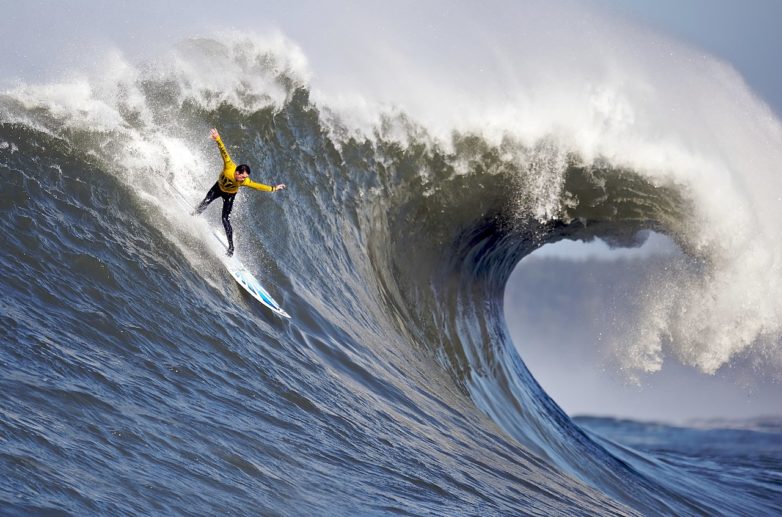
For purposes of sociological preciseness, a clear definition, of what is meant in this paper by the term "surfing" is necessary. Webster's Seventh New Collegiate Dictionary (1963) defines "surfriding" as "the sport of riding the surf on a surfboard" (P. 885). This is not a particularly enlightening description. More specifically, surfing is the act in which an individual slides across the surface of a cresting wave standing on a surfboard.
Within this definition are several technical elements of the sport which require additional elaboration. Finney and Houston (1966) provide an excellent description of the technical process of surfing in their anthropological study of ancient Hawaiian surfing:
"A man surfs today in much the same way as did the Hawaiian kings of old. The most arduous part, of course, is paddling through rushing surf to the take-off point. The ideal place to catch a wave is where its face is steepest, so the surfer gets in position just beyond the breaking place and waits for a set to build. As the wave he chooses humps up to cover the horizon, he points his board toward shore and, to gain speed, digs his arms in and starts paddling...When the board is moving fast enough, he feels the wave's power suddenly take hold. Speed increases as he begins sliding freely down the slope. Then he jumps to his feet in the center of the board. ...Today, except while learning or under unusual circumstances, standing is still the most popular position.
Once on the wave there are two places, to ride. One can ride "straight off" in front of the bouncing white water. This is the more amateur and often the most dangerous way to ride, especially in big surf where the foam itself may be a wall six feet high. It is more exhilarating to angle the board to the right or left immediately after take-off and cross the wave's as-yet-unbroken face with the white water leaping and roaring behind you. The resulting speed is a combination of the wave's forward motion and the board's "across" motion. The surfer then is skimming down a bottomless incline that continues building below him as the wave-form carries him shoreward.
When the ride is underway, success depends on the surfer's grace and balance and his ability to judge when and where the wave will break. The surfer can't allow his board to tip too far forward or water will grab the nose and he will "pearl-dive" while his board bounces to shore. Neither can he stand too far back on the tail, or the board rears up, loses its grip on the wave, and stalls. Stalling, however, works to the rider's advantage if he wants to slow down until the break catches up with him, thus maneuvering again into the faster part of the wave.
He controls his ledge-like position in the wave with foot movement and shifts in body weight. By leaning one edge into the wave in the direction he wants to turn he guides his board smoothly across the curling wall. Near shore he may turn into the break and ride "soup" to the beach, or he may whip his board over the wave top and paddle back to the take-off point. If a wave breaks on him he may leap off the board, grab its, nose if he can, and dive under to ride clear of the wave on its seaward side. If he falls off or is knocked off, the board usually gets to the beach by itself, and the surfer, of course, has to swim for it (pp. 18-20)."
Surfers utilize two major categories describing the way in which one fulfills the technical goals of surfing. The size of the wave ridden is one distinguishing characteristic. "Small wave" surfers are those who prefer to ride waves from 0.3 m to 2.4 m in height, "medium wave" surfers are those who prefer to ride waves from 2.4 m to 3.6 m in height, and "big wave" surfers are those who prefer to ride waves from 3.6 m in height up to the largest waves ridden, which are 9.0 m in height. A second characteristic which distinguishes surfers is the way in which they "perform" or ride the waves. There are three basic "styles" of surfing. Briefly, they are "hot-dogging," functional riding, and big wave surfing. "Hot-dogging" refers to a stunt riding style of surfing, characterized by many trick positions and acrobatic stances. It is a dramatic style meant to "show-off" and demonstrate control in the surf. Functional riding, is a style which focuses on riding the steepest and fastest, most difficult portion of the wave without a lot of unnecessary movement. The emphasis in this style is on speed and maneuverability on the wave. The big wave style of surfing is very similar to functional riding, except for the added danger that very large waves impose. The focus in this type of surfing is survival while overcoming both the wave and one's fears.
A second technical element within surfing is the equipment used while riding a wave. Without the proper equipment the entire nature of a sport is altered. An example of this principle is sliding down a snow-covered slope in a sled. This cannot correctly be considered skiing. The goal (sliding down the mountain) and the location (the snow-covered slope) may be the same, but the equipment clearly changes the nature of the activity.
In surfing the most elementary piece of equipment is the surfboard. Modern surfboards usually range in size from 1.5 m to 3.0 m in length, and weight between 2.5 kg to 5.5 kg. They are most commonly constructed of a carefully designed polyurethane foam core and covered with fiberglass and resin. The board also has one or two foiled fins laminated to-the underside at the rear for directional stability. The length, width, thickness, and contours of a surfboard vary according to the size of the surfer, his experience, the type of wave he expects to ride, and the style in which he does so.
There are five major factors intrinsic to Santa Cruz that have earned it the title "surf city" in northern California. Many of these factors are applicable to major surfing areas throughout the world, and these similarities, as well as the differences, will be noted in reference to the Santa Cruz area.
Surfing is not new to the Santa Cruz area, it has long been considered the surfing capital of northern California. Surfing was introduced to Californians in 1907 (Finney & Houston, 1966, p. 90), and demonstrated in Santa Cruz soon after. However, it was not until a second demonstration in 1938 that surfing remained there as a popular recreation (Rudnicki, 1975, p. 4).. This period of time is an indication that a surfing tradition has had an opportunity to become established.
The first factor which is essential to any surfing area, be it major or minor, is the presence of "rideable" waves.
"A rideable wave does not spill over all at once; rather, one section--the section moving through the shallowest water--will break first, and the spilling white water will spread from there across the wave as it rolls to shore, until the entire wave is white water (Finney & Houston, 1966, pp. 16-17)."
A wave of this type is ideal because the surfer's objective is to slide diagonally across a wave's face, keeping ahead of the breaking foam.
Because of the primary importance that the wave has within surfing, there are many terms and concepts the surfer uses to describe a wave's origins, shape, parts, texture, and strength. An experienced surfer will usually know the day's tide table, wind conditions, swell direction and strength, and from these variables be able to accurately estimate which surf spot(s) will have the most desirable waves.
An interesting phenomenon which demonstrates this rideable wave principle clearly is Big Surf. Nearly all rideable waves occur on a large natural body of water, particularly the earth's oceans. A major exception consists of a commercial enterprise in Arizona which created it's own manmade waves. Big Surf was constructed in Arizona at the peak of national surfing popularity in the 1960s, and has remained in operation since that time. As a result of Big Surf's operation, a geographical region totally alien to waves, or a large body of water for that matter, adopted surfing as a popular activity, and the same surfing subcultural phenomenon can be found there that is observed at any of the popular surfing beaches along the East and West Coasts of the United States.
The Santa Cruz County coastline is blessed with just under 67.6 km of beautiful beaches and dramatic rocky coastline. Its rocky points, coves, and sandy beaches provide many excellent surfing beaches, some of which have received international recognition for the quality of their waves. The Santa Cruz area has rideable waves year round, and usually, as the tide and wind conditions change, all day long. Included in the appendix to this report is a map of the Santa Cruz area with a code indicating many of the most popular and commonly used "surf spots." There are several more spots that are surfed within this area, but they are generally not as popular or as consistent, and have not been included for these reasons.
The second factor essential to an area in order for surfing to develop is a climate, particularly the water temperature, which is not so severe that it totally discourages potential swimmers and surfers. For example, there are good waves off the coast of Newfoundland, but no one surfs there. The water is simply too cold.
A study reported in the California Coastline Preservation and Recreation Plan, 1971, demonstrates this point. The state's coastline was divided into three-sections: the North Coast (Oregon to Golden Gate), the Central Coast (Golden Gate to Point Conception), and the South Coast (Point Conception to Mexico), and a survey was made of the types of activities participated in by those who used the coastline. The results showed that along the South Coast 70% used the beaches for swimming and wading; along the Central Coast 50% reported using the beaches for swimming and wading; and along the North Coast 18% of those surveyed used the beaches for swimming and wading. Surfing participation shows the same type of usage pattern, with 40%, 6%, and 2% for each respective section of coastline. This shift in the type of beach use correlates very closely with the decrease in air and water temperature as one travels north along California's coast. In the summer months the temperatures range from approximately 20 C in San Diego, to about 13.3 C along the California-Oregon border. In the winter months this figure will drop 4.8 C to 6.6 C along the entire coast. Along the northernmost beaches, temperatures in this range are clearly too cold for a pleasant dip.
With regard to this factor, Santa Cruz has a definite advantage over most other surfing areas in Northern California. It is located on the northern edge of the Monterey Bay. The advantage to this is that the water within the bay is less exposed to the wind and cold ocean currents of the Pacific. In addition, its shallow bottom and sunny summer weather combine to warm the bay's waters noticeably. Surfers will often discuss the temperature differences between the surf spots outside of the bay compared to those inside of the bay's influence. In reference to the map provided in the index, the warm area extends from Steamer Lane (number 8) to Palm Beach (number 27). It is easy to see the effect of ocean temperatures on the use that any particular area receives. Not only are the number of popular surf spots greater within the bay, the amount of use each spot gets is dramatically different.
To reiterate, Santa Cruz is one of the northern-most popular surfing areas in California, and it is only fair to note that relative to most other major surfing regions, it is considered frigid. During the winter months (November through April) surfers must suffer temperatures as low as 8.9 C. During the summer the water may warm up to 17 C, but it is hardly to be compared with the mild ocean temperatures of southern California or Hawaii.
An important technological development has improved the northern Californian surfer's plight considerably. This is the development and commercial distribution of neoprene rubber suits, much like those used by skin divers, to protect the bare skin from the shock of exposure to severe wind and water temperatures. Surfers generally refer to these rubber suits as "wetsuits" although there are various names describing each brand and style of suit. These wetsuits are readily available for purchase or rent through the several "surf shops" that cater to the needs of surfers in the Santa Cruz area.
The increased acceptance of wetsuits as standard surfing equipment has had a great impact on surfing in Santa Cruz. Before 1965 wetsuits were not used as much as they are today and the result was that many would-be surfers were not willing to suffer the cold water unprotected. Gradually a style of wetsuit known as a "vest" was introduced and accepted. It covered the surfer's upper abdomen only, and left the arms bare much in the fashion of the regular vest from which the wetsuit got its name. By the time that this style of wetsuit was accepted, a new style was introduced which covered the lower abdomen and upper thighs. The story goes on, and today many surfers use wetsuits which cover nearly their entire body, including feet, hands, and head, leaving only their face exposed. The effect of the wetsuit has been to encourage those who were unwilling to participate before, to try surfing, and often to remain as active participants.
A third factor which has made Santa Cruz an important surfing area is the fact that there is public access to much of the coastline in the area. This is a result of the fact that Santa Cruz is basically a resort town. It has very little industry, and therefore, the county's coastline and its accessibility is an important economic consideration if the area is to attract tourists.
A recent study correlating coastal urbanization with the growth of surfing found a positive relationship to exist (Crisalli, Note 1). There are two reasons for this relationship. The first is the presence of a large population from which to draw the surfing subculture's members. The second is the accessibility of the coast to that population. The access factor may be demonstrated very clearly by again referring to the map of Santa Cruz surfing areas in the appendix. Clearly, that section of the Santa Cruz coast which is the most heavily urbanized, also has the greatest number of surf spots and is the most heavily surfed.
The author has consistently observed that a relatively inaccessible surf spot may have better quality waves, yet be surfed less frequently simply because of the difficulties or "hassles" of getting there when a more accessible spot is "breaking." There are three major access factors which serve to discourage regular surfing use: exclusiveness, cost, and distance. Exclusiveness represents those areas which are not legally accessible, such as private beaches, or beaches for which the only access is to trespass on private land. Depending on how sympathetic the owners are to surfers, this may represent only a slight hassle, or it can be the most serious, since the surfer is breaking the law to gain access. Difficulties of this type are exemplified in Santa Cruz by those beaches which are marked private or toll public parks on the map of commonly-used surfing areas included in the appendix.
The second negative access factor is cost. This factor is an important consideration under two circumstances. First, a beach or surfing area may be a toll beach, in which case the surfer must pay to gain access to the waves. Second, the beach may require transportation expenses such as gas costs. This factor is an especially important consideration for those surfing areas far removed from urban areas. In the Santa Cruz area an example of this-is "the country," or those surfing spots north of the Santa Cruz urban area, also referred to as "up north." In order to surf the beaches up north, one must usually have access to a car and to the money to buy gas to reach this area.
Distance, the third negative access factor, is closely related to costs. Even without expense as a consideration, however, surfing a distant beach usually requires more time, effort, and the risk of unfamiliar beach conditions.
While accessibility represents an important factor in the development of surfing in any geographic area, it is the actual population of an area which creates and uses these accessible regions. A population which is receptive to surfing is perhaps t he most important factor necessary for the surfing subculture to develop. There are two basic ways in which a population must be receptive to surfing. First it must have a sufficient amount of energy, time, and money to .invest in the sport. These three represent the three basic economic demands that a population must be able to fulfill in order to participate in any leisure activity, and surfing in particular. The fact that surfing exists only in areas where a population can afford such expenditures supports this hypothesis. Surfing is not participated in by the poverty-stricken of Africa, South America, or the United States; too much of their time, money, and energy must be expended in the necessities of survival. The other condition of a "receptive'' population is the compatibility of surfing with the value system of the population. For example, a population which finds activities in the ocean, leisure activities in general, or semi-nudity legally or morally offensive, would not consider surfing a desirable activity.
The Santa Cruz area contains a population which satisfies both of these conditions. It has an urban population with a significant number of economically advantaged members, people who can afford the expenses, time, and energy necessary for leisure participation. The fact that Santa Cruz is primarily a beach resort town is a clear enough indication that the population is not unfavorable to ocean-related leisure pursuits, such as surfing.
The fifth and final factor necessary for a surfing subculture to exist in an area is the introduction of the sport and its skills to a receptive population. The chances today of surfing arising spontaneously in an area are very few. The rapidly expanding influence of modern communications, coupled with the travels of surfers throughout the world, are making sure of that. Modern surfing has spread any of three ways: It has been observed in the media and sparked some interest in an area (this occurred in France); it has been introduced by surfers traveling through or moving into an area (the form of cultural diffusion which occurred in California); or it has been observed in another area and brought home with those who fancied it (this form occurred in Peru).
With regard to this factor, surfing was introduced to Santa Cruz after it was demonstrated by Hawaiians traveling through the area. It has remained there as a regular feature of the area since that time.
These five geographical or social factors are necessary for surfing to develop in an area. It is the abundance of these factors which have led to this study of surfing in Santa Cruz, for while surfing exists in many areas of Northern California, nowhere in this region has it developed in size or complexity as it has in Santa Cruz.
While many romantic images of the modern surfer have been projected by the media, relatively little sociological data has been collected describing surfers. To acquire any data regarding surfers, it was necessary to conduct a survey in the Santa Cruz area.
This survey represented a "first effort" to describe statistically those who surf in the Santa Cruz area. The purpose of the survey was, to define who surfs, explore what surfing means to those who surf, and discern other social attitudes and concerns surfers have. Beyond this basic descriptive information, this investigation had two additional purposes. First, to design an instrument to measure the degree of personal involvement any subject may have in the surfing subculture from the data that was returned. Second, to correlate the subjects' degree of involvement in the surfing subculture with demographic and attitudinal data in order to establish a better understanding and description of the surfing experience.
Subjects. It has been estimated that in 1971, there were as many as 400,000 surfers in the state of California (Department of Parks and Recreation, 1971, p. 108). The total active surfing population regardless of residence in the Santa Cruz, California area is believed by the author to number from 4,000 to 5,000 persons; however, there are no known reliable data available at present on this subject. The subjects for this sample were 65 respondents from a survey population of 260 surfers. The survey was conducted at 11 popular surfing locations in the Santa Cruz, California area during the month of July, 1974.
The questionnaire. The questionnaire consisted of 23 items. Emphasis was placed on appealing to the respondents' cooperation and honesty, and they were assured complete anonymity. The questions were divided into two groups: the first group of 15 questions related to the subject's background; the second group of 8 questions asked about the subject's opinions and attitudes. A sample questionnaire is included in the appendix to this report.
Procedure. The method of selection for this survey was unique. During a three week period in July, 1974, the researcher went to each of the surfing spots in Santa Cruz County attempting to arrive when surfing conditions were relatively good. When this requirement was met, the surfers actually in the water were counted, and divided by one-fourth (rounded to the nearest whole number). This figure represented the sample size for each surfing beach. This method could be referred to as a selective quota sampling technique.
As each subject emerged from the water, they were individually approached by the author and assisted in completing the questionnaire. This procedure was repeated until the sample quota was reached. This method was designed in order to avoid biased sampling, to assure that all those sampled actually surfed, and to get as broad of a sample as possible. There are two disadvantages to this method. First, a few of the surfers were chilled from their time in the water, and hurried through the questionnaire without giving very much information. The second disadvantage consisted of the fact that surfers rarely surf alone, and often several companions with similar backgrounds emerged from the water at the same time, giving similar responses to the questionnaire items. This circumstance also created the possibility that the presence of the subject's peers may have influenced their responses on some items.
The demographic results of this survey are summarized in the following pages along with relevant material from other sources.
Age and age range. Tom Wolfe (1968) describes his impressions of the age of surfers at a southern California beach in this way:
"This beach is verboten for people practically 50 years old. This is a segregated beach. They can look down on Windansea Beach and see nothing but lean tan kids. It is posted "no swimming" (for safety reasons), meaning surfing only. In effect, it is segregated by age (p. 22)."
The survey results showed that the subjects' ages ranged from 10 to 53 years of age. This broad age range is illusory, however, for the median age of the subjects was 21, and 68.4% of the sample were between the ages of 10 and 21, reflecting a relatively youthful population for an area whose median age is 33.1 (U. S. Department of Commerce, 1972, p. 66). A poll of Surfer Magazine readers conducted in 1969 tends to confirm these survey results. The results indicate that the median age of their readers was 17.2 years, and that 83%. were 21 years of age or younger (Surfer Magazine, 1970, p. 2).
The differences between the Santa Cruz survey results and those of the Surfer survey may be interpreted in any of several ways: first, it is possible that older surfers do not read Surfer Magazine, or at least do not respond to questionnaires; second, it is possible that surfers in the Santa Cruz area are generally older than their counterparts in other places around the globe; and third, the time difference between the Surfer survey and the Santa Cruz survey may mean that today more older surfers are remaining active in the sport, and/or fewer young people are beginning to surf than in 1969. The author' s observations of surfers suggest that all three of these explanations do have some basis in fact for explaining the survey differences.
Age as a factor in the surfing career will be discussed further during another section of this paper. For the present it is sufficient to state that the surfer's motivations for surfing, his involvement with the sport, and the meanings that he derives from the activity will change, or at least be different at different stages or ages in his life.
Social research studies on the ages of those who participate in sport seem to concur that youths in any society, but more especially in industrialized societies, show greater interest in sport and sport groups than any other age group. J. S. Coleman's book, The Adolescent Society (1961) describes the important role that sports hold among adolescents in the USA. From the available data, it appears that Tom Wolfe's representation of surfing as a youth-oriented sport is not altogether unfounded. The fact is, over two-thirds of those who surf in the Santa Cruz area could be considered youth. While the data revealed that surfing is not a sport exclusively for the young (there were four subjects, 6.25%, over the age of 30), the fact remains that the great majority of surfers are 21 years of age or younger.
Sex. The sex distribution among surfers is another characteristic trait. In a county in which 47.6% of the population is male (U. S. Department of Commerce, 1972, p. 66), this survey revealed that a conspicuous 98% of the surfing population of Santa Cruz were male. The Surfer Magazine data again confirmed these figures, showing that 80.4% of the magazine's readers who responded to the poll were male.
The difference between the Santa Cruz survey results and the Surfer Magazine poll may in part be due to the different populations from which these were taken. Another factor contributing to this difference may be the relatively harsh climate and ocean temperatures that Santa Cruz is known for, and which discourage all but those most determined to bear the discomforts. This is not to say however, that there are not any females committed to surfing, for there are several very dedicated female surfers.
Social research on the sex of those who participate in sport has found comparatively slight interest. The most relevant research on this subject is a study conducted by Rosenberg and Sutton-Smith (1959, pp., 165-170), which concludes that in modern societies women are more interested in games of strategy and chance, and men are more interested in competitive sports and games of skill. These conclusions are indeed reflected in the large percentage of males participating in surfing.
Marital status. Marital status is another demographic variable which reflects the surfer's unique character. This survey indicates that only 7.8% of Santa Cruz's surfing population are married. This characteristic is accentuated by the Santa Cruz County population statistics, which indicate that 54.5% of the entire county's population are married (U. S. Department of Commerce, 1972, p. 66). The Surfer Magazine poll results again support the Santa Cruz survey data, showing that 7.3% of the respondents are married.
It is only fair to note that the youthfulness of the surfing population may significantly contribute to the low percentage of married surfers; however, when only surfers 21 years of age or older (N = 35) were analyzed, the percentage of married surfers remained relatively low (16.7%).
One further statistic which should be noted in relation to surfers marital status is the category of "living together." This status, in which the subject is living with someone of the opposite sex, was represented in this survey by 12.5% of the surfers interviewed. While there is no information regarding the quality of this relationship, it seems apparent from this data that this type of relationship is preferred by surfers over the traditional marriage relationship.
Social stratification, social mobility.
"The thing is, everybody, practically everybody, comes from a good family. Everyone has been reared well as they say. Everybody is very upper middle, if you want to bring it down to that. It's just that this is a new order (Wolfe, 1968, p. 26)."
There is no question that sport in Western societies is no longer an exclusive privilege of the leisure class, for whom it was one of their main activities (Veblen, 1931). The claim that sport like other "mass leisure" activities is not related to social-class, however, does not appear to be accurate either. Most studies of sport as it is related to social-class show that "sport is organized along social-class lines, and this may even indicate that there are hardly any leisure activities that are not structured in this way (Grupe, 1972, p. 129).
The survey results tend to support the view that sport is linked to social-class. Using the surfer's parents' social-class status determined by Hollingshead's Two-Factor Index of Social Position as the most reliable measure, 70.7% of those surveyed had middle or upper-middle class origins. Perhaps even more significant is the relatively low percentage (15.4%) of surfers whose origins are working or lower class. The actual breakdown of the survey results are as follows:
Table 1 Distribution of Santa Cruz Surfers' Social-Class Origins (using Hollingshead's Two-Factor Index of Social Position) Class f % I 14 21.5 II 18 27.7 III 14 21.5 IV 7 10.8 V 3 4.6 Unusable Responses9 13.8 N = 65 99.9
It is important to observe that a large percentage of the subjects did not provide adequate data to include them in this table; however, the author's subjective impressions of the interviews as they were conducted indicated that these subjects were fairly evenly distributed among the several social class status's. For this reason it is believed the data accurately reflects the social-status origins of those surveyed.
There are two other indications as to the social class origins of those who surf. The first of these indications is the Surfer Magazine editor's conclusion that the median family income of those who responded to their survey was $12,210 per year. To put this figure in some sort of perspective, the median family income for the entire United States in 1969 (the same year as the Surfer poll) was $9,586 (U. S. Department of Commerce, 1975, p. 395). In addition, the median family income in Santa Cruz County for 1970 was $9,078 (Carey, 1974, p. 48). Admittedly, these statistical populations do not coincide perfectly, but they are close enough to indicate that, in general, surfers originate from families of average or above income levels.
A second clue which may indicate social class status origins are the values and other life interests of those who participate in surfing. Many of the values and norms of those within the surfing subculture will be referred to throughout this report, but at this point other social class related sports interests which surfers may have should be noted. Sociologists have concluded that "participation in sport versus watching sport increases generally in proportion to higher social status (Grupe, 1972, p. 129). With this generalization in mind it is interesting to note that in response to the item on the Santa Cruz survey questionnaire in which the subject was asked to list his three favorite activities other than surfing, 78.8% of the subjects answered with at least one identifiable sport, and many responded with more than one sport. Activities which might be considered games (e.g., chess) or hobbies were not included in the category of sport. In contrast only 4.6% of the subjects listed items which could even vaguely be associated with work activities. One surfer, who was a student and part-time carpenter, listed academics and carpentry; another surfer stated that he "liked to work with his hands;" a third, who listed his occupation as an artist, included his art as one of this three favorite activities.
The type of sport one participates in may also reflect social status. The three sports referred to most often for the same question were snow skiing, tennis, and hiking, sports which have consistently been associated with the middle-class as compared with the lower-class (Hodges, 1964, p. 166). Harold M. Hodges' text, Social Stratification, listed seven sports activities associated with the middle-class; all of these sports were listed as favorite activities by surfers in Santa Cruz. Conversely of the five sports activities listed as being preferred by those in the lower class, only two were mentioned.
The data as it has been presented indicates that surfers in the Santa Cruz area originate from predominantly middle or upper-middle class families. Furthermore, the data seems to reflect a significant absence of participants whose social-class origins are low. It could be hypothesized that this phenomenon is in part attributable to the economic demands of surfing referred to earlier in this report; and second, certain ethnic characteristics of Santa Cruz County which are closely associated with the lower social-strata.
The occupational status of the surfers surveyed in the Santa Cruz area reflected the youthfulness of the population. The results showed that 50.8% of those surveyed listed "student" as their current occupation. The Surfer Magazine poll again confirmed these results indicating that 86% of the readers who responded were students.
The distribution of the non-student surfing population's social position is presented in Table 2.
Table 2 Non-Student Santa Cruz Surfers' Current Social Position Class f % I 1 3.1 II 3 9.4 III 10 31.3 IV 13 40.6 V 5 15.6 N=32 100%
As Table 2 demonstrates, excluding students, the large majority of surfers surveyed currently occupy middle or lower-middle class positions. This information would seem to indicate that a significant amount of downward intergenerational mobility occurs among surfers. Table 3 presents the available data.
Table 3 Directions Of Intergenerational Mobility Among Non-Student Surfers In The Santa Cruz Area Mobility Pattern f % Upward 3 12 Stable 5 20 Downward 17 68 N= 25 100
Comparing the social position of origin for the subjects included in this table, it was found that they were distributed in almost the same way as the entire survey sample as shown in Table 1. This data is particularly significant when compared with the 18-36% of the total U. S. population that are downwardly mobile (Lipset & Zetterberg, 1966, p. 568). This type of mobility pattern among sports participants is not altogether new and has been recognized by some sociologists (Loy, 1969, p. 109).
A downwardly mobile trend such as this is understandable considering the prime importance that athletic achievement has for the adolescent. This is especially true in surfing which rarely has any connection with other legitimate development-oriented institutions (i.e., school). Another explanation for many surfers seemingly casual attitude towards a career, is the middle and upper-class tendency to emphasize choosing an occupation which is congenial to the person, rather than for its economic benefits (Hyman, 1966, p. 493).
The author's observations in surfing have indicated that this mobility pattern is true. Surfing, when it is considered in its cultural as well as physical sense, makes several difficult demands of its active participants. First, professional opportunities in surfing are extremely rare; therefore, to surf regularly the surfer must find some other means of support. Second, successful surfing depends to a great degree on the physical conditions that exist where it takes place. For this reason if a surfer wants to surf under optimum surfing conditions, he must be able to "go out" when and where it is light, there are waves, and the tide and wind conditions are right. This combination means that the surfer must either work at a job which allows him flexibility in the hours he works, or he must be supported by someone else. These factors may also help to explain why such a large percent of those who surf are students. Going to school conforms to parental requirements for support and lets the student maintain a relatively free schedule (especially at the college level).
There are two variables which cannot be overlooked that do modify the conclusion that surfers are generally downwardly mobile. First, because they are young most surfers are only beginning their careers, while they were reporting their fathers' latest career attainments. Second, it is possible that those surfers who remain in school will achieve higher social positions than their peers who are working, thus eventually altering the results of the survey.
The author's observations indicate that surfers are not very career-oriented. When those in the survey were asked what their occupational goals for the future were, 41.5% did not have any idea what they intended to do. Most of those who did, had only vague notions, and were very likely to name jobs which did not conflict with their plans for leisure time and a surfing lifestyle. Again, Tom Wolfe's(1968) observation of the surfer's attitude toward the future and a career is accurate:
"God, if only everybody could keep on living "The Life" and not get sucked into the ticky-tacky life with some insurance salesman sitting forward in your stuffed chair on your wall-to-wall telling you that life is like a football game and you sit there and take that stuff. The hell with that (pp. 34-35)."
In conclusion, those surfers who remain actively involved in surfing tend to choose careers which minimize interference with their surfing activities. The leisure-centered lifestyle leaves little room for work. Surfers usually consider work a necessary evil that interferes with their surfing way of life. The ideal occupations are those related to the sport, either in promotion, production, or sale of surfing equipment.. The value of independence is very important among surfers, and many choose careers as artists, craftsmen, or small, independent businessmen. If none of these jobs seem possible, surfers will often work at jobs which maximize their free time. This is done either by working seasonally, earning enough to live the rest of the year; or by working at night so that mornings and afternoons are free.
Race and ethnic origins. There is very little statistical data concerning the racial or ethnic origins of surfers in the Santa Cruz area, however, there are several observations related to minorities which are important enough to be included in this report. Most of the sports sociology research done on minorities has reflected the special upward mobility function which some sports have for the participants (Grupe, 1972, pp. 136-138). Surfing, like most other sports, offers "the possibility of objective evaluation of results, individual performance, and no exercise of power over others (Grupe, pp. 136-138). Here the parallels begin to break down. Surfing requires a coastal location, surplus money, time, and energy to make it a practical activity. Those minorities who do not live near the coast, and lack the transportation, money, or time are already eliminated as potential surfers. There are very few professional positions available within the sport, so the chance to improve one's social position through surfing excellence is extremely slight. In addition the rewards the professional receives are not very great in comparison to the money that sports like football or basketball provide. In other words, the surfer's reasons for surfing do not normally include the opportunity for upward mobility; as previous data has indicated, this rarely, if ever, occurs.
The Santa Cruz surfing survey questionnaire did not include an item which asked racial or ethnic origins; however, since it was believed that there were minority characteristics among surfers which should be noted, notes were kept on each subject's ethnic background from visual and verbal clues. While this data is not particularly accurate, it enables the advancement of several observations and hypotheses. Table 4 compares the minority composition of Santa Cruz County with the results of the informal survey results.
Table 4 The Racial And Ethnic Composition Of Santa Cruz County Compared With Surfers In The Santa Cruz Area White Sp. Amer. Non-White County* 84.0% 11.8% 4.2% Surfers 92.3%(60) 3.1%(2) 4.6%(3) (N=65) *Roger T. Carey, ed. op. cit., p. 28.
The most obvious difference between the two sets of statistics in Table 4 is the relatively low percentage of Spanish-American surfers. There are two basic explanations for this phenomenon. First, the Spanish-American population of Santa Cruz County supply the vast majority of the county's farm laborers and cannery employees and are therefore concentrated in the lower socioeconomic classes. For this reason many Spanish-Americans cannot afford the luxury of an active leisure sport. Second, most of these people are still very much emersed in their Spanish cultural heritage, and surfing is generally outside their cultural boundaries.
Throughout the Spanish-speaking world, very few native surfing groups have appeared. When they have, it has been only those from the wealthiest classes. In Mexico, the only native surfers observed have been from middle or upper-middle class families with their own cars and all the latest surfing paraphernalia. Peru is another country which exemplifies this cultural tendency; in Peru "it was the young men of the well-to-do class, already interested in beach recreations, who quickly took up surfing and have continued to support it. Today Peruvian surfing is characterized by a luxury found nowhere else in the surfing world!"(Finney & Houston, 1966, p. 99).
There are also some observations within the non-white category, which should be noted. The first of these is the relatively high proportion of surfers who are of Chinese, Japanese, or Hawaiian extraction. The major reason for this is that modern surfing was originated in Hawaii by the native Hawaiians. Hawaii is still considered mecca by surfers around the world, and if one is able to claim some association with "the Islands" through travel, friends, relatives, or ethnic background, it can immediately improve one's status in the eyes of fellow surfers. In other words, there are certain positive sanctions associated with the "Hawaiian" look. I have observed friends of Filipino, Japanese, Chinese, or Spanish-American origin who quite consciously cultivate their "Island image."
Another racial characteristic of surfers is the general absence of African-American participants. In the author's thirteen years of surfing, only six to eight African-American surfers have been observed. It is believed that the same factors which limit Spanish-American participation, also limit African-American participation. These are economic limitations, geographic limitations, and a well-established subculture which does not include surfing as a desirable option. This tendency seems to be breaking down, and most of the African-American surfers observed have appeared in the past three years.
In concluding this section, it has been found that surfers do not discriminate against any particular race or ethnic minority. There is a certain fraternal feeling among surfers as long as one conforms to the subcultural expectations of surfing, regardless of race or ethnic origin. What discrimination that does exist, is the result of the basic prerequisites of the sport itself.
The second purpose for conducting this survey was to design and test an instrument to measure the degree of personal involvement that any surfer may have with surfing. In a participant sport like surfing, it seems logical to assume that the most clear and easily acquired indicators of involvement with the sport are the amount of actual participation. In fact, this is what most sociological studies of sport have used when a quantitative measure of sports involvement was desired. Consequently, two variables based on time have been used as the primary measures of surfing involvement.
The first of these is the length of time that any surfer has been surfing. It is assumed that an athlete who has surfed for ten years has demonstrated a greater commitment to surfing than one who has been surfing for six months. This factor must not be overemphasized, however, for there are two major drawbacks to relying totally on the length of participation in a sport. The first problem is that the surfers relationship with surfing and its relative importance in his life may change several times over a long time period. The length of participation does not measure this. Second, the length of participation does not measure the present intensity of the involvement. Surfers who have surfed one or two years may be totally involved in the surfing life, and others who have been surfing many years may approach the sport rather casually.
The second quantitative variable used to measure surfing involvement attempts to deal, with the question of intensity. For this measure the subjects were asked to estimate the number of times they have been surfing in the last year. Thus, a surfer who participates almost daily, would demonstrate more involvement in surfing than the "weekend" surfer does. This type of item is used most often in sports research, as a single measure of sport involvement.
Because of the subcultural approach used in this study, participation in the sport itself is not adequate for measuring a surfer's involvement in the "surfing life." In order to design an instrument which is sensitive to social interaction, two additional items were included in the surfing survey which reflect a surfer's involvement in the surfing subculture. The first of these items asks the subject to indicate the relative proportion of his friends who also surf:
Item 12: How many of your friends surf? (Circle one) (None) (A Few) (About Half) (Most) (All)
This question is meant to provide some insight into the reference group which the subject identifies with, and the degree to which surfing is a shared activity. The assumption being made in this question is that, the greater the proportion of friends who surf, the greater will be the subject's involvement in surfing.
The second question included as a measure of lifestyle involvement is also a subjective evaluation on the part of the subject. He was asked to indicate the relative proportion of his time spent surfing or in surfing related activities:
Item 13: How much of your time do you spend surfing or in surfing related activities? (Circle one) Very Little ------------------------------------------------ Most 1 2 3 4 5
This item was designed to evoke a response that reflected the subject's perception of the relative importance of surfing in his activities. It is assumed that the more time a subject believes he spends surfing or participating in surfing related activities, the greater will be his total involvement in the surfing subculture.
A fifth question concerning involvement in surfing was included in the questionnaire for general summary purposes, and again reflects a subjective opinion on the part of the surfer. Item 19 asks the subject: "How committed to surfing do you feel you are?" Because of its direct, open-ended nature, this question was meant both as an additional indicator of surfing involvement, and as a check on the other survey items related to the measure of surfing involvement.
As noted earlier, the most common measure of sports involvement used in the sociological study of sports is the number of times the sport is participated in by an individual during a certain n interval of time. Because of this precedent, and the author's observations, this measure was chosen as the primary measure of surfing involvement. It is not believed by the author that this single measure is sufficient to accurately reflect all involvement in surfing; therefore, a series of four hypotheses have been constructed in order to test the contribution that each of the five questions just described makes to measuring involvement in the surfing subculture.
A formal statement of the first hypothesis is as follows:
Hypothesis 1:
Ha: Subjects who have surfed more frequently between July, 1973 and July, 1974, will tend to have been surfing more years than subjects who have surfed less frequently between July, 1973 and July, 1974.
The data used in testing this hypothesis came from the survey of Santa Cruz surfers conducted during the month of July, 1974, and the collection of which has already been described. The Chi-square statistic was used for computing the relationship among these sets of variables. The results of the test of this hypothesis are shown in Table 5:
Table 5 Surfing Frequency And Years In Surfing Surfing Frequency Years in Surfing (times/year) 0-2 3-5 6-8 9-up 0 - 50 11 8 4 1 51 - 200 4 5 6 5 201 - up 0 3 3 10 (N=60) df = 6 Chi-square = 22.66 p<.005
The data clearly demonstrates that there is a significant positive relationship between these two variables. Surfers who have been surfing for several years tend to surf more frequently than those who are just beginning.
One of the primary reasons that this phenomenon occurs is because those who have been surfing longer have cultivated more social ties related to this activity, and this in turn reinforces their desire to participate in surfing. In other words the surfer will have more friends who surf, and thus have more reason and opportunity to go surfing. As a subculture, this tendency should be particularly related to participation. In his text on subcultures, David Arnold (1970) observes that "persons belonging to the same population segment tend to interact more with each other than with persons belonging to other segments" (p. 114). This observation is directly related to the discussion of the Structural-Interactionist model referred to in Chapter one of this paper, with special attention to the second element, differential interaction. In order to test this postulate a second hypothesis was developed.
Hypothesis 2:
Ha: Subjects who have surfed longer and with more intensity will tend to have more friends who surf than those who have not surfed as long or as often.
To test this hypothesis it was necessary to combine the longevity and intensity scores into one score. This was done by first locating the scores for each of these variables at the median distribution point in Table 5. This shows that the median surfer has been surfing approximately 5 years, and has surfed about 90 times during the last year.
The author's experience and intuition, or "verstahn," indicate that the length of time one surfs is not as important in measuring current surfing involvement as the frequency of participation. Therefore a surfing involvement score of ten points was assigned for each year a subject has been surfing. Thus the cumulative surfing involvement score equals the sum of the reported frequencies plus the years in surfing times ten:
Surfing Involvement Score = Surfing Frequencies + (Years Surfing x 10)
Pretests on this formula showed that it worked satisfactorily for the purposes of this study. The results of the data for the second hypothesis are shown in Table 6:
Table 6 Surfing Involvement Score And Proportion Of Friends Who Surf Surfing Involvement Friends Who Surf Score None/Few About Half Most/All 0- 9 0 14 2 91-250 4 5 9 25l-up 0 6 16 (N=60) df = 4 Chi-square = 25.56 p<.005
The data again show a significant positive relationship to exist between the two variables and Hypothesis 2 is shown to be correct. The relationship between the three variables presented thus far are so closely related that they seem to confirm the subcultural significance of participation in surfing.
Two additional items were included in the survey questionnaire, but because their content overlaps the three original items, they will be used as test items to challenge or confirm the validity of the Surfing Involvement Index.
The Surfing Involvement Index consists of the cumulative points of a surfer's years in surfing, multiplied by 10, his frequency of participation, and the proportion of his friends who surf multiplied by 25. The value of 25 was assigned to this third item on the basis of the author's assessment of its relative importance. The scores for the answers to Item 12 were achieved in the following manner:
None 0 x 25 = 0 Few 1 x 25 = 25 ~ half 2 x 25 = 50 Most 3 x 25 = 75 All 4 x 25 = 100
Thus Surfing Involvement Index (SSI):
SSI = (Years Surfing x 10) + Surfing Frequencies + (Proportion of Friends x 25)
Subsequent tests of this formula also confirm the accuracy with which the Surfing Involvement Index (SII) measures a surfer's current involvement in surfing.
The first such test was a correlation of the SII with the responses to Item 13 on the Santa Cruz surfing survey.
Hypothesis 3:
Ha: Subjects who have higher SII scores will tend to believe they spend a greater portion of their time surfing or in surfing-related activities than those with lower SII scores.
The results of the test for this hypothesis are shown in Table 7.
Table 7 SII Scores And Proportion Of Time Surfing Or Related Activities Proportion of Time Surfing/Related Activities SII Score 1&2 3 4&5 0 - 150 11 5 2 151 - 300 3 8 9 301 - up 1 5 15 (N=59) df = 4 Chi-square =.22.34 p<.005
As Table 7 shows, there is a significant positive relationship between Santa Cruz surfers' SII scores and their perceptions of the proportion of their time spent surfing, or in other activities they believe to be related to surfing. The test confirms the accuracy of the SII.
The second test of the SII was a correlation of the SII scores with the answers to Item 19 on the survey questionnaire. Item 19 is an open-ended question and three commitment categories were discerned. Answers to this item were usually short and clear, but for purposes Of clarification examples are provided.
Low commitment: "I am not committed to surfing at all." "None." "Not very." "For pleasure only." "At present, very little."
Moderate commitment: "I wouldn't let it run my life." "Not to the extent I should be, . . . there are other areas which are just as rewarding if not more so." "Very committed if the surf is good, if it's bad, not at all."
High commitment: "Totally committed." "Zombie commitment." "101%." "It is 3/4 of my life." "Don't want to do anything else."
The hypothesis for this test states:
Hypothesis 4:
Ha: Subjects who have higher SII scores will tend to feel more committed to surfing than subjects with lower SII scores.
Table 8 shows the results:
Table 8 SII Scores And Feelings Of Commitment To Surfing SII Score Low Moderate High 0 - 150 11 4 2 151 - 300 3 5 9 301 - up 0 7 15 (N= 56) df = 4 Chi-square = 23.62 p<.005
The results of this test confirm Ha 4, and validate the usefulness of the SII. There is a significant positive relationship between Santa Cruz surfers' SII scores and their feelings of commitment to surfing. The more involved in surfing a surfer becomes, the more likely that he will express strong feelings of commitment to the sport and the subculture of surfing.
The SII appears to provide a simple, sound measure of surfing involvement. There is a significant statistical relationship between the variables relied upon in constructing the SII. The author's intuitive understanding of surfers also leads to the conclusion that the SII is accurate. Finally, previous sports research have often relied on one or more of these variables as a means of measuring sports involvement. The tests of the SII have all shown that it is a reliable measure and is a useful tool for studying other aspects of the surfing world.
The SII has been applied to a few other items in the Santa Cruz surfing survey to test hypotheses which contribute to an understanding of the surfing experience.
One of the hypotheses constructed has come out of the description of social stratification in surfing given earlier in this paper. It is based on the observation that surfers are more likely to come from the middle and upper-middle classes. With the use of the SII, it was possible to test the relationship between social class origins and a subject's involvement in surfing.
Hypothesis 5:
Ha: Subjects who have higher SII scores will tend to have higher class origins than subjects who have lower SII scores.
Table 9 displays the results of the test of this hypothesis.
Table 9 SII Scores And Social Class Origins Class SII Score 1 2 3 4&5 0 - 150 3 4 5 2 151 - 300 6 8 3 3 300 - up 6 5 5 4 (N=54) df=6 Chi-square = 2.71 p<.10
The results of this test show that the null hypothesis is true. There is not a correlation between Santa Cruz area surfers' SII and their social-class origins. In fact, there is the distinct possibility that a curvilinear relationship exists between these variables; however, there is not sufficient data at present to investigate this.
A second hypothesis is related to the geographic variable of accessibility. Two very basic geographic mobility patterns operating within the surfing subculture have been observed. First, people who live near the coast are more likely to participate in recreational activities related to their geographic region, like surfing; second, those who are heavily involved in surfing tend to move to coastal areas with good surf if they do not already live there. While there is no way of discriminating between these two with the data available, Item 11 on the survey questionnaire does establish the subject's residence with reference to a surfing area. Item 11 asks:
How far do you live from the nearest surfing area? (Less than 1 Mile) (1-10 Miles) (Over 10 Miles)
The first answer indicates that the subject lives in an area closely associated with surfing. The second answer indicates that the subject lives in Santa Cruz County generally, but is not living in a beach area. The third answer indicates that the subject resides outside of Santa Cruz County and at least 10 miles from a recognized surfing area. From the observations made by the author regarding where surfers live in relationship to surfing areas, a sixth hypothesis was formulated.
Hypothesis 6:
Ha: Subjects who have higher SII scores will tend to live closer to a surfing area than subjects who have lower SII scores.
The results of the test of this hypothesis are shown in Table 10 below:
Table 10 SII Scores And Location Of Residence Relative To Surfing Areas SII Score Under 1 mile 1-10 miles Over 10 miles 0-150 6 3 9 151-300 11 6 3 301-up 13 8 1 (N=60) df = 4 Chi-square = 12.91 p<.05
Table 10 indicates that there is a significant relationship between a subject's involvement in surfing and the distance that he lives from a surfing area. Viewed from a practical point of view, it is understandable that surfers who live near a surfing area find it easier, less time consuming, and less expensive to surf regularly than those who live relatively far away. It is also easy to understand why highly involved surfers prefer to move nearer a surfing area when it becomes possible to do so. In addition, as the results of H a 2 have shown, surfers who are highly involved in surfing tend to be homogeneous and prefer to associate with other surfers. This tendency includes where they live. These are the primary ways the tendency for surfers to reside near surfing areas is continually reinforced.
A final hypothesis is based on the author's observations of the "meaning," or subjective functions that surfing has for surfers at different levels of involvement. This type of inquiry has only been done a few times within the context of sports or leisure sociology (Neulinger & Breit, 1969, 1971; Steele & Zurcher, 1973; Stone, 1970). The results of these studies have shown that there are several functions a leisure sport activity may provide. The best of these sport function reviews is presented by Steele and Zurcher.
A review of the responses to Item 23 in the survey questionnaire revealed three major types of meanings which surfers associate with their surfing activities. These three categories are:
(1) Surfing as a casual "sport" activity, "just for fun;"
(2) Psychological functions such as Catharsis, Relaxation and Recreation, Identity Generation, and the Social Function of Separation; and
(3) Surfing as a "way of life.
Several examples from each of the three categories of surfing functions are included here in order to clarify them:
1. Surfing as a fun sport activity: "Surfing means fun." "It's just another sport." "Surfing means a good day at the beach." "Exercise." "Not much."
2. Surfing as catharsis, relaxation, recreation, separation: "It's a way of being with nature and expressing yourself through her." "It means being able to enjoy myself in the atmosphere of the ocean." "It gives me peace of mind and relaxes me." "A feeling of freedom." "A total escape from life's pitfalls." "It's something I can do something about."
3. Surfing as a way of life: "Surfing means a good life." "It means being next to the source of life." "A way of life." "Life. "Everything."
These three categories represent clearly distinguishable perceptions of what surfing means to the surfer. Using these categories as dependent variables Hypothesis 7 states:
Hypothesis 7:
Ha: Subjects who have higher SII scores will tend to place greater subjective meaning on surfing's role in their life than will subjects who have lower SII scores.
The results of this hypothesis, as shown in Table 11, reveal some interesting data:
Table 11 SII Scores And The Functions Of Surfing SII Score Fun--- 1--------- 2----------- 3--- Lifestyle 0 - 150 13 4 1 151 - 300 6 7 5 300 - up 3 9 9 (N = 57) df = 4 Chi-square = 15.04 p<.005
The data results show that there is a significant positive relationship between the variables of surfer involvement and the surfer's perception of the role of surfing in his life.
As stated in the introduction to the statistical section of this paper, there were three major purposes for conducting the Santa Cruz Surfers Survey: first, to collect basic descriptive information about surfers; second, to construct an instrument for measuring a surfer's involvement in surfing; and finally, to correlate this instrument with a few items included in the survey in an effort to further understand the surfing experience. All three purposes have been accomplished, and achieved significant results.
The data shows that Santa Cruz area surfers are primarily young, male, single, and have middle and upper-middle class origins. In addition, the survey data compares very closely with data from other available sources.
The construction of the Surfing Involvement Index resulted in powerful levels of significance between the number of years a surfer has been active in the sport, the number of times he has surfed during the one year period preceding the survey, and the proportion of his friends who surf. In addition, significant relationships were found to exist between the SII scores and two other items meant to measure involvement in surfing, confirming the accuracy and usefulness of the SII.
Finally, by correlating the SII scores with other variables, significant relationships were found to exist with: the location of surfers' residences relative to surfing areas, and surfers' subjective perceptions of what surfing means in their lives. It was also found that no Significant relationship exists between the SII scores and surfers' social class origins.
While much of the data collected and tested proved to be valuable, there are some suggestions which would improve the quality of any subsequent research of this nature. The first of these suggestions is related to the mechanics of the survey, and the other suggestions are related to the questionnaire itself.
It goes without saying, that almost any survey would benefit from a larger sample size. This survey would have been bolstered considerably by this single fact. A larger sample size would have contributed both to the statistical reliability of the study, and would have also allowed further elaboration concerning several aspects of surfing.
The sampling technique left some things to be desired, but it was sufficient for an exploratory study of this type. Any further studies of surfing should consider the possibilities of studying only a few surf spots over the same time period; or a study which includes samples of surfers during-the winter season and during the summer season. There may be a significant difference between the two seasons.
The questionnaire used was found to be an appropriate length for a survey distributed at the surf area. It was necessary to assist each subject as much as possible to avoid abbreviated responses, to get honest cooperation, and to avoid the shivery handwriting and soggy questionnaires many of the subjects returned. In the future the questionnaire should be kept as brief as possible. More close-ended items should be included for brevity and ease of handling's sake, but it is important to listen and record any and all expanded responses that are offered.
The subsequent section is meant to be a synthesis of the surfing subculture, a collage of impressions, observations, interviews, and other resources presented in such a way that the surfing scene is not only observed, but felt as well. The term "feel" is used because the enthusiasm and devotion of surfers, the "social energy" this subculture possesses, help to make surfing such a unique experience.
While structuring the data collected on surfing, the concept of sport involvement has been very useful. Gerald S. Kenyon (1969) formulates a very clear and well-integrated .conceptual scheme for studies of sport involvement in his article "Sport Involvement: A Conceptual Go and Some Consequences Thereof." He refers to involvement as "social action related to some manifestation of sport" (p. 78). He then distinguishes three dimensions of involvement: the behavioral aspect refers to participation within the sport; the cognitive refers to knowledge of sport features and requirements, and knowledge of current sporting events; and the dispositional dimension refers to attitude or emotional involvement.
Kenyon notes further that there are two basic of behavioral involvement. Primary involvement refers to those who actually participate in the sport as players, or contestants. Secondary involvement refers to all other forms of participation. These include those who participate as consumers of the sport, such as spectators, viewers, readers, etc.; or those who participate as producers, such as members of the sport's governing body, the manufacturer's of sport goods, the promoters, and the retailers.
In order to provide a frame of reference in which to put these aspects and the relevant data, Kenyon suggests viewing involvement from a temporal perspective, very similar to Arnold"s concept of peripheral marginality. As Kenyon (1969) states: "This allows us to consider involvement in three stages: becoming involved, being involved, and becoming uninvolved" (p. 81).
Chapter IV is structured to present data relevant to primary participants. Using the temporal perspective as a frame of reference, data will be provided which reflect the three dimensions of involvement referred to earlier: behavioral, cognitive, and dispositional.
To start an involvement with surfing the prospective surfer must borrow, buy, or rent a surfboard and "hit the surf." It is an individual sport, and there does not need to be any-large investment of time or money in order to try the sport. There are few restrictions about where one surfs in Santa Cruz. To start surfing, there is no necessity to know someone on the "inside" who can sponsor the beginner, or someone to apprentice themself to. The rules of the sport are simple: paddle out into the lineup: catch a wave; stand up on the surfboard; and do the best you can. The subcultural rules of interaction are not so simple.
The beginning surfer or "kook" soon finds out that becoming a surfer is not easy. As the term "kook" implies, the status of a humble beginner is very low. Kooks are generally blamed by more experienced surfers for overcrowding surfing areas, getting in the way, "dropping in" on a wave someone is already riding, losing their boards and creating a danger to others, and worst of all, being "uncool" (not knowing correct surfer behavior).
Getting a surfboard to try surfing may present a problem in itself. New surfboards cost anywhere from $130 up to $300, and a new wetsuit will cost an additional $40 to $100. Unless the beginner is certain he wants to remain in surfing, this kind of investment is foolish. Renting a used surfboard is another matter. Surfboards are rented at three or four surf shops in Santa Cruz and the board can be rented for about $4 a day. In addition, wetsuits can be rented at these shops for a fairly reasonable rate. But what often happens when the beginner tries to rent a surfboard? The following description is a typical beginners experience as observed by the author.
As the beginner enters the shop he is usually dazzled by a brilliant assortment of shiny new surfboards, and the faint odor of fiberglass resin is in the air. Asked if he has been helped by a tan, shaggy-haired man in his early twenties, the beginner replies that he would like to rent a surfboard. He suddenly receives some suspicious glances from two boys in surf trunks (bathing suits) and sandals who were talking to the salesman when he arrived. Another tan young man with his shirt tied around his waist by the sleeves, quickly peers at the beginner past a colorful surfboard he was carefully inspecting. The salesman flashes a mysterious grin and leads the beginner to a dark rear corner of the shop where a few old-fashioned, dirty, dinged-up, ugly surfboards are stacked. After choosing the correct board and a rental wetsuit with only two patched-up tears in it, he is ready to leave. As the new surfer awkwardly starts for the door, the salesman calls "Good luck!" and one of the two boys standing near the sales counter quietly calls out "Cowabunga!" in a deep, fakey voice followed by several snickers and more mumbling that is not quite understandable. By now the beginner is well aware of the four pairs of eyes openly staring at him as he passes the neat rows of the latest model surfboards with the raunchy rental, two tan young girls enter the shop and greet the three boys at the counter. As the door shuts behind him their shrill laughter echoes in his ears. While he clumsily tries to tie the surfboard onto his car, he suddenly realizes that even when he arrives at the beach, he will not escape recognition, not with a surfboard like this one.
In interviews with the owners of two of the most prominent surfboard rental shops in Santa Cruz, it was found that during the summer months they rent an average of two to five surfboards a day. During the winter months they rent from two to seven boards a week. Weekends were their busiest times both winter and summer. It is obvious that considering the number of people who surf in Santa Cruz, very few rent their boards. If the beginner is fortunate enough to know someone who owns a surfboard and is willing to loan it to them, the painful prospect of getting the board some other way is averted.
Beyond the equipment there is the beach. There are literally dozens of beaches in the Santa Cruz area. Surf shop owners or sympathetic friends may direct the beginner to one of the beaches that have gentle, easy waves for riding; otherwise, he must take his chances. The beach most well known as a beginner's beach is Cowells (9 on the map in the appendix). By comparing the level of surfing involvement at each beach, it was found that indeed, subjects using Cowells had the lowest median SII score of any of the beaches surveyed. Other surfing areas associated with beginners are Inside Pleasure Point (13) and Manresa Beach (24).
If the beginner ends up at a surfing spot that is being used by several, more experienced surfers, the chances that he will be reminded of his inferior status are very good. First of all he will probably not be able to handle the waves that are being ridden at this spot. This spotlights him immediately. The beginner is constantly swimming to shore to get his surfboard, other surfers are always catching the waves before him, and he keeps drifting out of the lineup before he realizes what is going on. Even without his lack of skill as a handicap, he is very likely to become conscious of other differences. If the kook happens to overstep his position as a beginner by committing one of the sins that beginners are most commonly blamed for, he will probably be quickly put in his place with comments like "kook" or "valley bug out." Many times these sanctions are not directed to the beginner personally, but there is usually little question about whom they are meant.
The demographic characteristics of those who begin to surf roughly parallels that of surfers in general. They are primarily from middle and upper-middle class families. The median age at which most surfers begin surfing is 14 years, and perhaps even more significant, is the fact that 89% of the surfers surveyed indicated that they started surfing between the ages of 10 and 17. A significant element in the surfing subculture is its youth orientation. Related to age, the marital status of the beginner surfer is very likely to be single.
The ways that individuals are influenced to try surfing are similar to the ways in which surfing has been transmitted throughout the world. The individual has first observed the sport, either in person or through the media, and found it interesting enough to try. Table 12 shows the-responses to Item 15 in the Santa Cruz surfing survey: "How did you first get interested in surfing?"
Table 12 Forms Of Introduction To Surfing f % Relations 33 57.9 Observation 18 31.6 Proximity 6 10.5 Total* N = 57 100.0 *there were 9 unusable responses to this item.
The responses show a remarkable similarity. The greatest proportion (57.9%) of the survey population had been introduced to surfing through a relative or peer. Those who indicated that they started surfing because they lived close to the beach were also implying that they were influenced by their own interaction with others already identified with the surfing scene. In addition many of those who started surfing because they observed the sport, either personally, at a movie, or in some other media form, observed it because of their interaction with relatives or peers already involved in surfing.
What this data means is that those who become interested enough in surfing to try it, have consciously or unconsciously recognized surfing as a "scene" or distinct group and a way of life, identified with members already participating in this scene, and have acted on this identification by participating in the activity. Obviously, there are those who cannot try surfing because they lack the opportunity; the youth of Wichita, Kansas for example, but in reference to Santa Cruz and the surrounding area, this is. not a significant factor.
The two forms through which this identification pattern is most commonly manifested are: an individual who identifies with a previously established, generalized or specific "in-group" of surfers; or a group who spontaneously encourage each other to start. In the first form, the individual is initiating himself into surfing with the goal of becoming either a "surfer," generally, or a surfer within a particular group. This form is a classic example within reference group theory of anticipatory socialization. In the words of Merton and Rossi(1966), they "take on the values of the non-membership group to which they aspire, find readier acceptance by that group and make an easier adjustment to it" (p. 512).
The second form through which this identification pattern is manifested is similar, but slightly different. It is a common tendency among surfers for a group of boys who already identify and associate with each other to adopt the surfing scene. This occurs most often to groups of young boys who live in a neighborhood very close to a beach where surfing is allowed or practical. The beach provides an accessible area where they are relatively free of adult authority, and the sport offers a means of acquiring status among their peers within the community.
Once surfing has been tried by a beginner, he must weigh the positive rewards of participation with the negative aspects of the sport. Without spending a lot of time describing the psychological motivation factors of surfing, the following list summarizes the important factors associated with surfing that tend to discourage or encourage the beginner's surfing career. The most common negative factors influencing the beginner's decision to continue surfing in the Santa Cruz area are:
1. The exhausting, painful, and cold experience that the beginner almost inevitably suffers.
2. The expense of participation, in terms of time and money.
3. The problem of getting to the beach regularly if he lives very far from the coast.
4. The humiliation the kook must endure until his status improves.
5. Disillusionment with or unwillingness to accept the norms and values associated with surfers.
On the positive side are:
1. The thrill, excitement and challenge of a successful ride.
2. The status that even a beginner can derive in the nonsurfing community.
3. The inspiring beauty and romance of the ocean and coastline.
4. The feelings of independence and self-sufficiency that the surfing subculture fosters.
5. The increased recognition received by significant others in surfing.
When the beginner decides that the rewards are sufficient, and believes that his status will improve, several commitments are made. A physical commitment is made to the extent that he is willing to put his health, or at least his comfort, on the line. A personal commitment is made to the extent that he is willing to put his identity on the line. A social commitment is made to the extent that he is willing to risk being rejected by other surfers.
The beginner who makes this choice must now accept the full burden of being a kook. He has wholly adopted the goal of "becoming" a surfer. Because sport activities are based on performance, status within the sport subculture is predominantly based on one's athletic prowess. This is very true within surfing. The most important thing a new surfer must do is master the basic skills of paddling, balance, turning, and wave judgment.
There are two more factors which can influence a kook's ascent to "surfhood." First, the kook must learn the proper cultural characteristics associated with being a surfer. Second, the kook may hasten his arrival as a group member through his association as a relative (brother, son, cousin, etc.) or as a friend of someone who is already a recognized surfer.
Surfers have several names for kooks who fail to meet their standards in one way or another. The "ho-dad," a "greaser or hood from the back streets, generally with a hopped-up car (Severson, 1987, p. 171), is considered a nonsurfer regardless of his actual skills, because he does not conform to the "proper" norms of association, language dress, or transportation. On the other hand, the "pseudosurfer" is someone who may associate with surfers, conforms to their norms, and even considers himself a surfer, but he does not have the skills of the sport mastered. A third type of beginner is the "gremmie" or "gremlin." The "gremmie" is usually very young, and is considered a pest and troublemaker. The gremmie is an ultra-conformist to the physical and verbal norms associated with surfing; he may even surf fairly well. His failure to master the basic surfer code of conduct is the reason he has not achieved full status. The gremmie has not cultivated the "coolness" that most seasoned surfers prefer.
Reference has been made several times to the cultural norms that the kook must learn in order to become a surfer in the full sense of the word. In order to clarify many of these cultural patterns, a look at the process that occurs hundreds of times each day in Santa Cruz as surfers evaluate each other's status in the surfing community is provided.
The setting for this description could be almost any beach in the Santa Cruz area. It is still early in the day, and the parking area adjacent to the beach or cliff is still relatively empty. A few small groups of young men and surfboards are scattered about on the sand. The waves are of excellent quality and there are several surfers already in the water. The narration represents the author's attempt to apply Ethnomethodology, and to make the "reflexive" character of this practical activity observable.
As one observes those who arrive at the beach area, the first symbol of surfing to watch-for is the way the surfboard is transported. Surfboards are constructed in such a way that it is almost impossible to transport them without being visible. The most common mode of transporting a surfboard is by commercially produced surfboard racks that are attached to the top of one's car. These racks are characteristic only of surfing and are distinctly different from other types, such as ski racks or luggage racks. The presence of these racks indicate that the subject knows of their practical benefit and surfs enough to invest in them. If there are no surf racks, acceptable ways to carry surfboards include carrying them under, the surfer's arm when on foot or bicycle, in the back of a pickup truck, inside a van, or as a last resort, some surfers manage to fit their board inside their car. The surfer almost never transports his surfboard by tying the board to the top of a car or luggage racks, or by letting it hang out the trunk of his car. In addition, the surfer almost never straps his board onto his surfracks so that the deck or top of the board is exposed to the sun. Surfboard racks are probably the most obvious indication that a person surfs, and is a symbol he carries with him wherever he drives.
The second symbol of surfing to observe is the type of transportation the subject is using. The ideal vehicles are vans (Volkswagen vans are quite common) or pickup trucks with a camper shell. These vehicles not only provide transportation, but also a home-away-from-home. At the beach they provide privacy, and on surfing trips they provide an inexpensive shelter. A second vehicle often preferred is the sports car. These range from the Porsche down to the Volkswagen Bug. The third vehicle common to surfers is the dilapidated old junk car. In this category, the raunchier the better. While a car is important to the surfer for getting to and from a surfing area, they rarely spend a lot of time pampering their vehicles. Surfers almost never drive the new, large, expensive, gas-consuming cars produced by American car companies, nor do they drive "souped-up" hot rods.
The third distinguishing symbol to observe when evaluating a subject's surfing status is his Surfboard. First, observe the shape and size of the board. If it is a shape and style that is currently popular among other surfers and shown in the latest editions of surfing magazines, the subject is more likely to have high status. Old-fashioned, impractical, or very dilapidated surfboards usually indicate that the subject is either old-fashioned or a kook. The brand of surfboard is important also. Any board manufacturer who has at least a half page ad in a surfing magazine is acceptable. Among the local surfboard manufacturers, Haut Surfboards are the most prestigious; however, there are several close competitors. Surfboards with board-bags (cloth covers) usually reflect surfer status. Finally, observe the way a surfboard is waxed. The deck of the surfboard is waxed to create a surface the surfer's feet can adhere to. If there is little or no wax on the board, the wax has been applied to the bottom rather than the top of the board, or the wax has been allowed to melt into large blobs collecting on the rails (sides) of the board, the subject is probably a beginner. Surfers prefer to get the wax on their boards into a dirty gray condition as quickly as possible and avoid the possible judgment that they do not surf regularly.
As the subject gets out of his car, one can observe the subject himself. His physical appearance will often indicate whether he is an active surfer or a beginner. The ideal overall appearance is one of total involvement in the surfing life: independence, sun, surf, and a touch of individuality. Active surfers are characterized by shaggy, sun-bleached hair that does not quite reach their shoulders. Crew cuts and Brylcream are definitely unacceptable. His face is usually clean-shaven, except, possibly, for a mustache. Super long hair or beards are rare among active surfers. His face, neck, hands, and wrists are tan from hours in the water and on the beach, even in the winter months. His neck and shoulders are often muscular, and his arms and wrists are well-developed from hours of paddling. His dress changes from season to season but his surf trunks and wetsuit are always present. His clothes are not new, and he is often wearing a Hawaiian or T-shirt, Levi's (blue-jeans corduroys), and will be barefoot or have tennis shoes or sandals (slaps, thongs, etc.) on his feet. The T-shirt is rarely plain, and often quite colorful (but slightly faded) with a symbol of surfing printed on it in the form of a wave or a prestigious surfboard manufacturer's name and insignia. His general appearance is one of carefully fostered casual, ruggedness. It reflects his physical pride in his body, common among athletes, tempered by the independent, masculine, "back-to-nature" image most surfers have of themselves. There are also distinguishable physical differences between particular surf groups in the Santa Cruz area, i.e., style of hair, facial hair, and language, but the symbols described here are common to nearly all surfers.
The clothing identified with surfers has hardly ever been an exclusive characteristic. The reason for this dates back to the time that surfing received nationwide publicity during the 1960's. What surfers wear and the language that they use are not just a reflection of its members' origins. Surfing styles continue to influence the general youth population. The diffusion of surfing styles has remained a strong influence on Santa Cruz youth and to a lesser extent on youth all over the United States. This phenomenon makes clothing a relatively unreliable symbol of surfer status unless one is extremely familiar with the surfing scene, and clothing is combined with other symbols.
Just as the physical symbols of surfing can be observed, the behavioral ones can also be evaluated. How does the subject act upon arriving at the surfing area? If he appears nervous or unexplainably excited(not appropriate behavior unless the waves are particularly good or large), he is probably a novice to the sport. The experienced surfer will casually but efficiently scan the area, evaluating the surf conditions and the beach scene. To act nervous would be a subtle admission to others on the beach that he is concerned with their evaluation of him and his competence as a surfer.
After the subject has "checked out" the surf, he may or may not interact with others who have come with him, or with some of those who have already arrived. If he does, the level of competence of those he associates with usually reflect his own degree of involvement. If the others are known to be "hot" (have superior surfing skills) he is very likely to be of the same caliber, as long as their response to him is positive.
A second symbol of competence related to association is the subject's use of language. The special jargon that a group uses is commonly considered one of the most significant characteristics of a subculture, just as it is for the general culture. Surfing has long been recognized for having a language all its own that only the experienced surfer really understands. In an interview with a local surf shop salesman, he explained that "the best way to recognize a beginner is the way he talks." The following description of riding a surf spot is an example of the experienced surfer's jargon. The words or phrases characteristic of surfers have been underlined for ease of recognition.
"Elands starts as a big peak when it's working properly at medium tide. Although you wouldn't feel bad riding Elands from three to ten feet either glassy or with strong offshores, six feet is perfect and a slight offshore is bit more comfortable. As the peak moves over the outside shelf and starts to feather, hand in unless there are eight foot sneakers, because the peak holds and holds until, nearly vertical, it hits the inside reef. Then, with one or two strokes you are suddenly on the peak along with the wall swinging in from left field to surprise you before you notice the transition. Plenty of time to go high or stall on the peak, even turns and cutbacks possible here, whoops--not too low--plenty kelp--it'll cut you down like a scythe if you go real low. Quickly, now, as the wall begins to act like a wall all peak characteristics are suddenly forgotten as it begins to peel and you start to move, hollow but mellow and sooo long you just cannot believe it. Go ahead, get behind it, even if you are a regular this wave is so perfect and God-like that it forgives you, nay it allows you to be an idiot, a kook, a fool and still not get hurt. If you do know what you're doing Elands can be the highlight of your life. It is so clean, so perfect you feel it's over too quickly. Then you begin the long paddle back out, past the perfect little right peak that no one surfs if Elands is on, past the inside lineup where you thought you'd eat it but didn't, past the inside takeoff point where you can get into the wall faster, all the way out to where the big peak and the wall meet and create a left so pure that surfing it is an honor (French, 1976, pp. 73-74)."
In addition to the language, the new surfer must become a surf lore expert; he must know the names and conditions of all the most famous surfing spots, locally and throughout the world; he must recognize on sight all of the current local and international surfing champions; he must know a brief oral history of surfing and its legends; and he should be familiar with the latest equipment and surfing maneuvers, even if he cannot perform them.
The final set of characteristics that symbolize a surfer's status is his proficiency. First, observe how he puts on his wetsuit; if he has a great deal of difficulty he is probably a beginner. Second, watch how he handles his surfboard. If he has a great deal of difficulty lifting and carrying his board, he is a kook. Beginners will often make the mistake of carrying the board in such an unbalanced way that the front or back of the board will angle awkwardly up in the air; one end of the board will drag in the sand; or worst of all, a friend will help him carry the board down to the water. The experienced surfer will appear to easily lift his board off his car and casually carry it tucked under one arm to the water's edge, either perfectly balanced or pointing slightly down in the front or back to avoid the embarrassment of having a sudden gust of wind lift the board out of his grasp.
The ultimate indication of the subject's status is his skill in the water. The judgment he uses in choosing where to surf, the ease with which he paddles out into the surf, his choice of takeoff positions, his choice of waves, his actual performance on the wave, all contribute to the evaluation of the surfer's status within the surfing community.
It would be misleading to state that any one of these symbols can be used to evaluate surfer status. This is rarely the case. Instead, the sum of all these observations can be an accurate and reliable reflection of the surfer's status in the surfing subculture.
If this description has given the impression that the surfer is often conscious of these symbols, it is absolutely true. The surfer, from the time he commits his first mistake as a kook, onward, becomes painfully aware of them. The attitude that develops out of this phenomenon is one of "putting on a performance." The beach area becomes a literal stage upon which one enters, participates as both actor and critic, and eventually exits. A very common and revealing phrase among many surfers is "play the role." They use this phrase not only to refer to their own behavior as surfers, but also generalize it to most of their behavior with others. This role consciousness is a large part of what is often referred to as the "coolness" or easy-going indifference of many surfers. The surfer's perception of the world as many "scenes" in which he "plays" his roles is a phenomenon which is relatively new as a part of the general public's consciousness. It would be interesting to investigate the origins and the consequences of such an attitude.
As the kook becomes socialized into the finer points of the surfing subculture and his skills improve, he can expect to slowly achieve greater status among his fellow surfers. The single most important indication that the surfer has finally achieved true "surfer" status is his acceptance as a full participating member of a surfing group. This does not occur all at once, but it is a significant stage in the surfer's career. This stage onward represents the involvement status "being involved" as referred to by Kenyon.
In a discussion of the functions of small groups in sport, Max Horkheimer (1964) claims:
"It is among his fellows, in sport and play, that the individual finds what for a long time neither home nor school . . . have satisfactorily given him, namely, the opportunity to assert himself by continual confrontation with others; to assert himself not only physically, but equally, through his character, his mind and his emotions. In the common effort which unites them, he is encouraged to reveal his different instincts, his preferences and his antipathies, and at the same time, to master them (pp. 176-177)."
As will be shown, the surfing group fits this description well.
Almost any surfable beach in the Santa Cruz area that is easily accessible has developed a group of "locals." Locals are the individuals who make up the group of surfers who consider a particular beach "theirs." This sense of territoriality is very important within the surfing scene. The particular beach is a symbol to the group of their "home" and their unity. They surf there whenever possible, lounge there whenever they can, party there regularly, and sometimes sleep there. It is jealously guarded territory much in the tradition of W. F. Whyte's (1955) description of "street corner" society. The major difference being that there is rarely any fighting, status is determined by competition on a surfboard rather than with two fists. The local is among the first to arrive at the beach in the morning, and the last to leave after the sunset. While he may surf at other spots during the day, he always returns to his own territory.
The locals are usually easy to identify. They fit the surfer image better than anyone else on the beach, and they are grouped on the beach where the greatest vantage point for observing the parking lot, the waves, and the beach is. They are also conveniently located near all the best beach facilities. Everyone who comes to "their" beach does not pass unnoticed. The Pump House Gang described by Tom Wolfe were locals. So are the groups that "hang out" at Rio, Manresa, Pleasure Point, The Hook, Twenty-sixth Avenue, The Harbor, Rivermouth, The Lane, and Capitola (see the map of popular Santa Cruz area surf spots in the appendix). Locals do not physically stop anyone from using "their" beach, but tourists and most visiting surfers alike are expected to accept their status as unwelcome "guests," if not intruders. Tom Wolfe (1968) provides us with some insight into a group of locals' command of their beach.
"All these kids, seventeen of them members of the Pump House crowd, are lollygaging around the stairs down to Windansea Beach...and they all look at the black feet, which are a woman's pair of black street shoes, out of which stick a pair of old veiny white ankles... She is standing with her old work-a-hubby...Obviously, these people come from Tucson or Albuquerque... All these hincty, crumbling feet come for the weekend.
"The black panther." "Pan-thuh. " "Poon-thuh." "Mee-dah."
Nobody says it to the two old crocks directly...
It is a Mexican standoff. In a Mexican standoff, both parties narrow their eyes and glare but nobody throws a punch. Of course, nobody in the Pump House crowd would even jostle these People or say anything right to them; they are too cool for that.
Everybody in the Pump House crowd looks over.
The old guy, one means, you know, he must be practically 50 years old, he says to his wife, "Come on, let's go farther up,..." but she says, "No! We have just as much right to be here as they do..."
They start to walk up the sidewalk, but one kid won't move his feet, and oh, God, her work-a-hubby breaks into a terrible shaking Jello smile as she steps over him, as if to say Excuse me, sir, I don't mean to make trouble, please, and don't you and your colleagues rise up and jump me, screaming Gotcha.
"Mee-dah!..."
"-Ooooo-eeee-Mee-dah!" They chant this chant, Mee-dah, in a real fakey deep voice, and it really bugs people. They don't know what the hell it is (pp. 19-22, 30)."
Almost every surfing group has its own set of special words in addition to the surfing vocabulary common to them all. The term "mee-dah" is not common to other groups because it only has a special meaning in the experiences of the Pump House Gang members, but nearly every group has its equivalent. These special terms and phrases also are symbols of acceptance in the group and should an outsider use them, he would be given the same looks the old couple in Tom Wolfe's description were given.
I have observed and participated in this scene many times, but more substantial evidence is the graffiti found near surfing areas. "Valley Bug Out!," "No Tourists Allowed," "Surfers Rule!," "RS0 is in Control!" all testify to the territorial nature of the surfing group.
One of the most powerful characteristics of surfing social structure during this stage in the surfing career is the absolute loyalty that the members have for the group. The popular singing group, the Beach Boys, wrote a song that stated: "None of the guys go steady 'cause it wouldn't be right / to leave your best girl home on a Saturday night." During the apex of the surfing group's solidarity, surfing and the activities of the group become more important than any other activities in the surfer's life. This loyalty is rewarded with high status in the group and a sense of unity that all members enjoy.
R. B. Alderman (1974) summarizes this sense of unity when he says:
"The love and affection people have for each other, and the feelings of belonging to an important group, tend to be emphasized when the group faces a common external threat. Nowhere can this be seen as well as in the strong camaraderie and friendship developed in competitive sport teams. When one trains, practices, sacrifices, and dedicates oneself, day in and day out, alongside close friends who are doing the same thing, a strong bond is forged. This becomes a significant motivational drive in the behavior and performance of these people. In order to gain insight into athletic behavior, then, it is obviously necessary to take into account the strong affiliative tendency operating in sport and physical activity (pp. 258-259)."
The surfing group has several characteristics beyond territoriality. The surfing group is an entity all its own. The members' faces change from season to season, year to year, and yet there always seem to be a set of locals at the surfing area.
Another characteristic of the surfing group is its competition with other groups. While loyalty to surfers, in contrast to nonsurfers, is a common rule, loyalty to the specific surfing group and pride in its status in the surfing community is also a prime consideration. This group's status position is evaluated most commonly on the surfing competency of the group's best members, and the group's overall conformity to surfing norms. The surfers who collectively started their own surfing group as beginners are faced with the problem of raising their status as a group, rather than as individuals entering an already established surfing group. This phenomenon operates as a form of collective upward mobility. Surfing groups occasionally "raid" each other's territory to clarify each group's status. These raids may take the form of a formally agreed upon "surf-off" or contest, a spontaneous "surf-off," or vandalizing another group's territory.
A last important characteristic of surfing groups is the presence of a "core" group of five to ten surfers who are essentially the group's leaders. They are the members most committed to the surfing way of life, not only because of their own desire but because every other member in the group depends' on them for their group identity and status. This inner core of friends always seem to be at the beach; always know where the best surf is; always know where the parties, surf movies, and group activities are happening. Their acceptance is absolutely essential to the young surfer trying to become a member within the group.
There are many indications to the surfer of his acceptance as a group member. The first signs of impending acceptance are the recognition and casual greeting in or out of the water by established group members. At whatever level of status in the surfing subculture, when those regarded as better surfers nod their head, smile, or simply say "Hi," the beginner has begun to arrive in their status range. A longer conversation is an even more significant sign of recognition. When those the beginners has respected begin to ask him his opinion regarding surfing or group-related activities, he can be fairly assured that he has arrived.
While one is surfing there are several opportunities for surfers to signal recognition and respect. Surfers will often allow another surfer of equal or better status to take a wave that he could have taken just as easily. When a surfer one respects offers him a wave, the chances are that his status among his fellow surfers has risen. By the same principle, one must show deference to surfers one believes to be of superior status.
Another situation in the water during which the surfer may give or receive respect is after he has observed another's ride. As they both paddle back out to the lineup together, or after they have both gotten back into position to catch another wave, one surfer may compliment the other on his ride, or on his choice of waves. If the surfers are not familiar with each other this scene functions to show respect and deference.
The sport of surfing has several characteristics which tend to contribute to group cohesiveness. First, the beach offers a natural territory all members can share equally in without being responsible for its maintenance. Second, rideable waves occur only at specific locations along the coast, so surfers find themselves interacting regularly at specific takeoff spots in close proximity of one another. This often includes sitting in position to catch a wave with several other surfers several minutes at a time during lulls in the waves, thus offering an excellent opportunity for conversation. Third, the excitement and intensity of the sport creates a special bond between those who share it, especially when they have shared several particularly good times in the water and on the beach. Fourth, when paddling back out to the takeoff area there are often opportunities for surfers to communicate the excitement of the ride and strengthen the, bond between them and with the surfing way of life.
An interesting characteristic of surfing groups is their tendency to give most of their members nicknames. This is especially true of the group leaders. It is certainly a signal of acceptance within a group when a surfer is given a nickname. The curious thing about the name is the way it describes what the group considers to be an undesirable characteristic. As examples, the nicknames of several of the members in the group the author participated in are listed:
Nickname Source The Hulk It rhymed with his last name, and his reputation for being strong. Fat Face He had a round baby-face. Carrot He had red hair. Titmouse He was the smallest, with big ears and teeth. Gopher The way he squinted without his glasses. Bubblegum Burn scars on his arms and chest. The Brain His tendency to get tongue-tied. Oakie The livestock his mother kept. Woman His thin waist.
Several international surfing personalities have nicknames which also describe them to some extent: "Gnat" Young, "Midget" Farelly, Mickey "The Cat" Dora, Greg "The Bull' Noll, etc. This is a phenomenon that occurs in other sports as well. It seems to serve four functions within surfing. First, it gives the recipient recognition in the group. Second, it gives those within the group special access to the surfer, for the name is often an insult if used by someone outside the group. Third, it is